
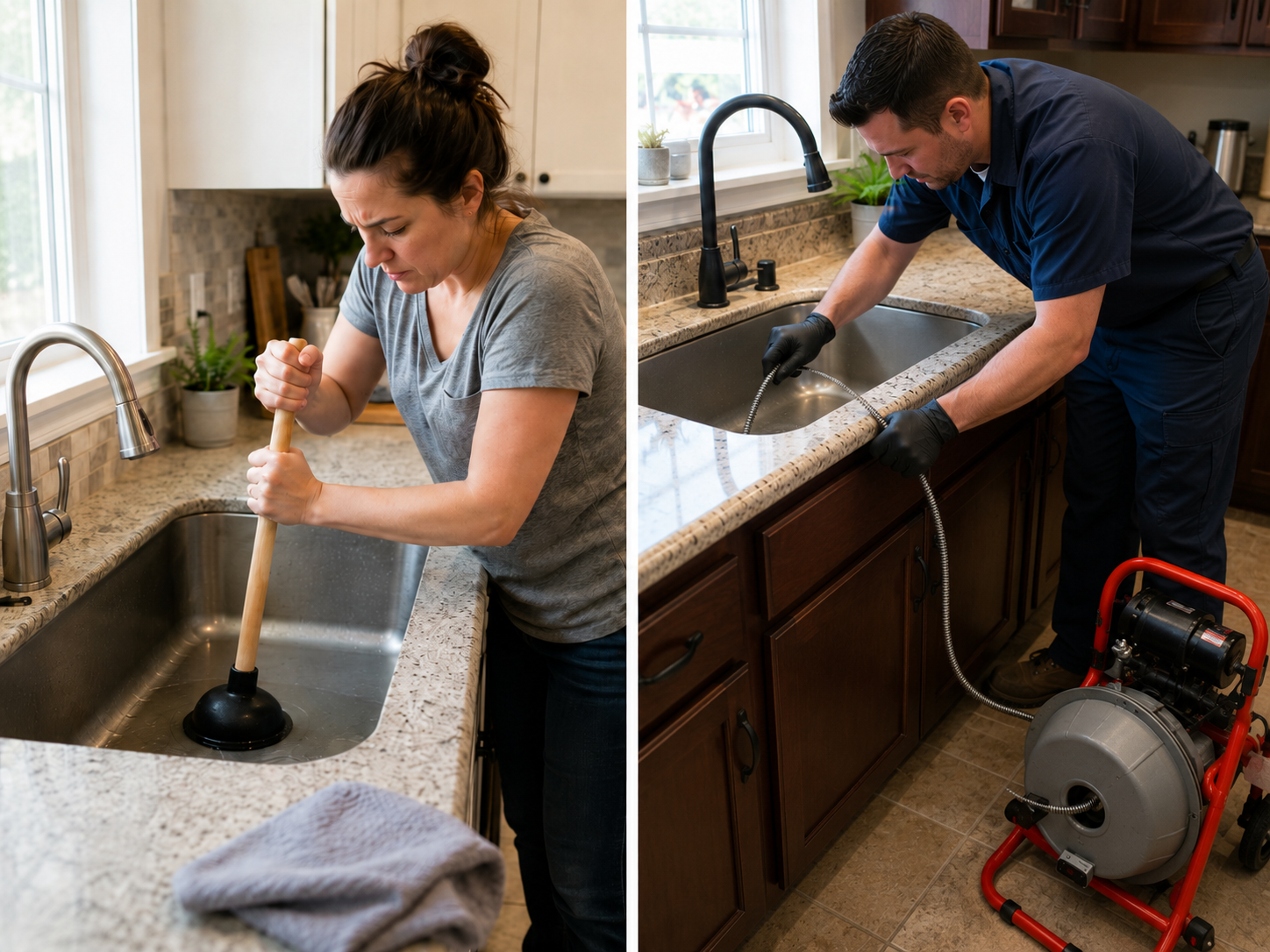
 For minor, isolated clogs—a slow bathroom sink or a hair-blocked shower drain—DIY drain cleaning is the smart, cheaper first move. For recurring backups, multiple slow drains at once, or any sewer-line symptom, professional drain cleaning wins because it removes the root cause instead of the surface clog. The right choice in the DIY Drain Cleaning vs Professional Drain Cleaning debate comes down to one question: is this a single, simple blockage you can see and reach, or a deeper system problem? This guide breaks down the costs, risks, and results of each so you can decide with confidence before a small clog in your Denver home turns into a flooded floor.
Understanding DIY Drain Cleaning
DIY drain cleaning is any method a homeowner uses to clear a blockage without professional equipment or training. It ranges from the genuinely effective to the genuinely risky.
How it works. Most DIY approaches fall into four buckets: physical removal (a plunger, a drain snake/hand auger, or a bent-wire hook to pull out hair), natural breakdown (the classic baking-soda-and-vinegar flush followed by hot water), enzymatic cleaners that digest organic buildup over hours, and chemical drain openers that use caustic or oxidizing reactions to dissolve clogs. For a clog you can physically reach within the first couple feet of pipe, a hand auger or plunger is often all it takes.
Typical costs. This is DIY’s biggest draw. A quality plunger or hand auger typically runs $15–$40 and lasts for years. Enzymatic cleaners usually cost $10–$25 per bottle, and a bottle of chemical drain opener is often under $15. For a one-off slow drain, you can frequently solve the problem for the price of lunch.
Core benefits. It’s immediate—no waiting for an appointment—inexpensive, and effective on the surface-level clogs that make up a large share of household drain complaints. Learning to use a hand auger is a genuinely useful homeowner skill, and there are plenty of safe DIY drain cleaning techniques that won’t put your pipes at risk.
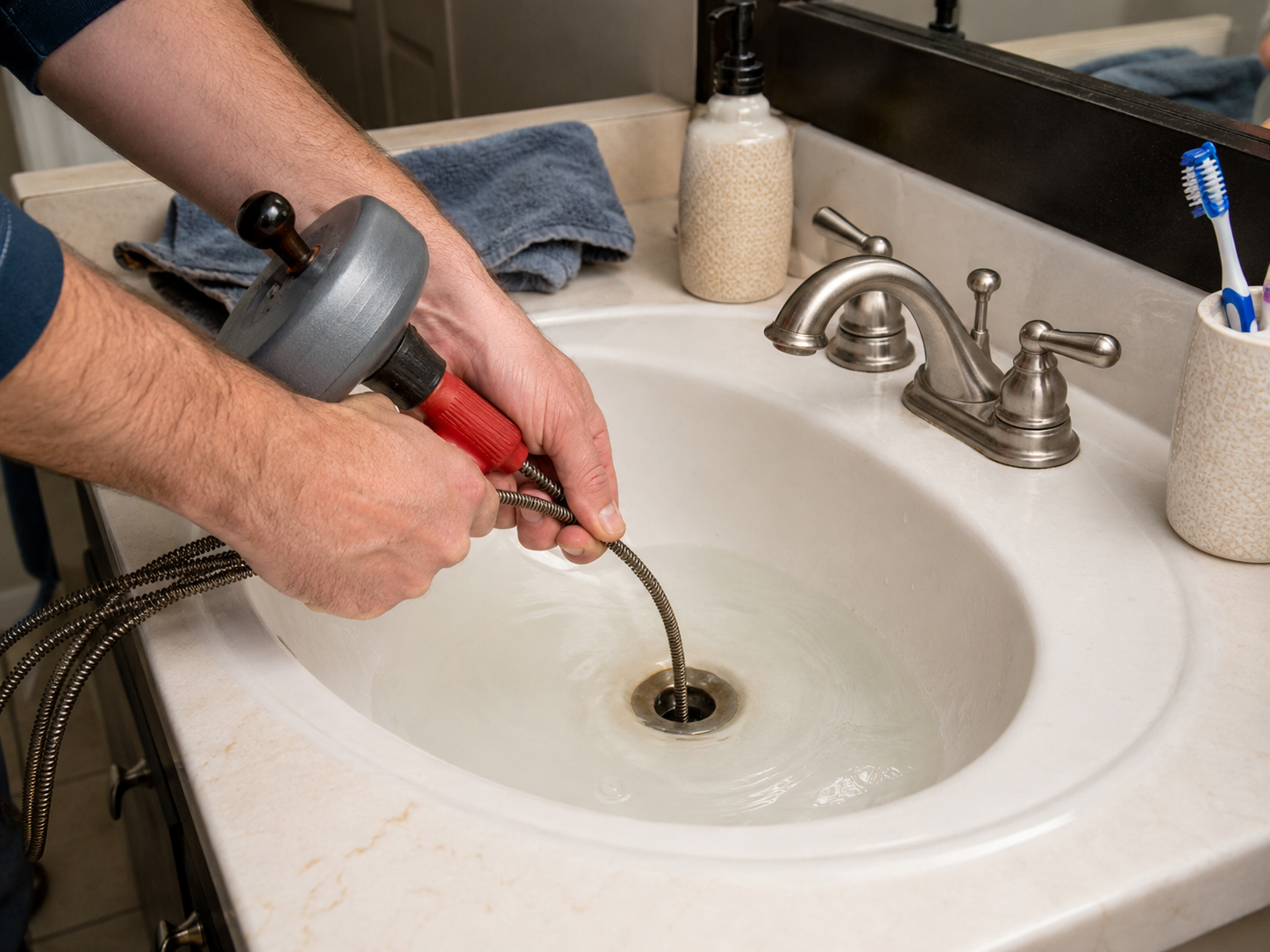 Ideal use cases. A single slow-draining sink, a shower drain choked with hair, a kitchen sink that’s sluggish after greasy cooking, or a toilet with a soft, recent clog. If only one fixture is affected and the water eventually goes down, DIY is the logical first attempt.
The catch. Liquid chemical drain cleaners are the part of DIY that worries plumbers most. Repeated use can corrode older pipes, and in Denver’s housing stock—where many homes still run on cast iron or galvanized lines—that corrosion is a real concern. Older homes are also simply more clog-prone to begin with, which is one of the top reasons drains keep clogging in older houses. Chemicals also don’t remove the clog so much as bore a hole through it, leaving the underlying buildup behind to re-form.
Understanding Professional Drain Cleaning
Professional drain cleaning uses commercial-grade equipment and trained technicians to clear blockages completely and diagnose why they happened.
How it works. A pro’s toolkit goes well beyond a hand snake. Motorized drain augers (drum machines) push a powered cable deep into the line to break up and pull back stubborn clogs. For heavy buildup, grease, and root intrusion, hydrojetting uses water pressurized to thousands of PSI to scour the pipe walls clean—not just punch a hole, but restore the line to near-original diameter. When the cause isn’t obvious, a sewer video inspection sends a camera down the line to pinpoint exactly where and why the blockage formed.
Typical costs. A standard professional drain cleaning visit often falls in the $150–$400 range depending on access and severity, while hydrojetting typically runs higher—often $300–$700 or more—because it clears the whole line. Pricing varies with the job, so treat these as ballpark figures; you can get current detail on local drain cleaning service costs in Denver and on hydro jetting costs in Denver before you commit.
Core benefits. A professional removes the entire clog, not just a channel through it, which means the drain stays clear far longer. Just as important, a trained tech can spot the warning signs of a deeper issue—a collapsed pipe, root intrusion, or a sewer line that needs repair—before it escalates into a sewage backup or a costly emergency.
Ideal use cases. Recurring clogs in the same drain, several fixtures backing up at once (a classic sewer-main symptom), water rising in a different fixture when you run another, a main-line backup, or anything you’ve already tried to DIY without lasting success.
Side-by-Side Comparison
| Attribute | DIY Drain Cleaning | Professional Drain Cleaning |
|---|---|---|
| Upfront Cost | $10–$40 for tools/cleaners | ~$150–$700+ depending on method |
| Effectiveness | Good on surface clogs; weak on deep/root clogs | High—clears the entire line to the source |
| Time & Effort | Minutes to hours; hands-on | Scheduled visit; technician does the work |
| Risk of Pipe Damage | Moderate–high with chemicals on older pipes | Low—equipment matched to pipe type |
| Diagnoses Root Cause | No | Yes (camera inspection available) |
| Best For | Single slow fixture, light hair/grease clogs | Recurring, multiple, or main-line clogs |
| Long-Term Value | Low for chronic issues; high for one-offs | High—solves the underlying problem |
Pros and Cons Breakdown
Pros of DIY Drain Cleaning
- Lowest cost — Most jobs cost only a few dollars in supplies you may already own.
- Instant action — No waiting for an appointment when a sink slows down on a Sunday night.
- Effective on simple clogs — A plunger or hand auger solves a large share of everyday blockages outright.
- Builds useful skills — Knowing how to snake a drain is genuinely handy homeowner knowledge.
Cons of DIY Drain Cleaning
- Surface-level fixes only — Most methods clear a path through the clog without removing it, so it often returns.
- Chemical risk — Caustic cleaners can corrode aging pipes and create hazards if they sit in a still-blocked drain.
- No diagnosis — DIY can’t tell you why the drain clogged, so root causes go unaddressed.
- Can mask bigger problems — Repeatedly clearing the same drain can hide a developing sewer-line failure.
Pros of Professional Drain Cleaning
- Complete clog removal — Powered augers and hydrojetting restore the full pipe, so results last.
- Root-cause diagnosis — Camera inspection finds collapses, roots, and bellied pipes you’d never see.
- Pipe-safe methods — Equipment is matched to your plumbing, avoiding the damage chemicals can cause.
- Prevents emergencies — Catching a failing line early is far cheaper than cleaning up a backup.
Cons of Professional Drain Cleaning
- Higher upfront cost — You’re paying for equipment, expertise, and a lasting fix.
- Scheduling — Outside of 24-hour emergency service, you may wait for an appointment.
- Overkill for tiny clogs — Calling a pro for a single hair-clogged shower drain isn’t always cost-efficient.
Which Option Is Better? The Ultimate Showdown
The honest answer to the DIY Drain Cleaning vs Professional Drain Cleaning question is that they solve different problems, and the smartest homeowners use both at the right time.
Cost vs. long-term value. DIY wins on upfront cost every time—but only on the surface. If you’re spending $15 on chemical drain opener every two months for the same kitchen sink, you’ve already out-spent a single professional cleaning that would have solved it permanently, and you may be quietly corroding your pipes in the process. For a one-time clog, DIY is almost always the better economic choice. For a recurring clog, the math flips hard toward the pro.
Choose DIY drain cleaning if your priority is cost and speed, only one fixture is affected, the water still drains (just slowly), and you’ve never had this clog before. Reach for a plunger or hand auger first—skip the harsh chemicals.
Choose professional drain cleaning if the same drain clogs repeatedly, multiple drains back up together, you notice gurgling or sewage odors, or you’re dealing with anything resembling a main water, sewer, or gas line issue. These are sewer-system symptoms, and no store-bought product reaches that far.
The Denver factor. Two local realities tilt borderline cases toward the pros. First, Denver’s older neighborhoods have a lot of mature trees, and roots love to infiltrate clay and cast-iron sewer lines—something only hydrojetting or sewer repair truly resolves. Second, Denver winters freeze and stress plumbing; a clog that seems minor in October can become an emergency backup during a January cold snap. When in doubt during a hard freeze, it’s worth knowing when to call a professional plumber instead of going DIY.
The verdict: Try DIY first for simple, single, first-time clogs. Go professional the moment a clog becomes a pattern or spreads to other fixtures. DIY treats the symptom; professional drain cleaning cures the disease.
Get Expert Help in Denver
If you’ve plunged, snaked, and poured, and that drain is still slow—or it keeps coming back—it’s time to stop guessing. The team at Drain Pros Plumbing is here to clear the clog at its source and tell you exactly what caused it, so it doesn’t return. Denver residents can schedule a professional drain cleaning or explore the full range of general plumbing services to get a clear, no-pressure recommendation for your home. Reach out for a consultation whenever you’re ready.
Conclusion & Recommendation
In the DIY Drain Cleaning vs Professional Drain Cleaning decision, there’s no single winner—there’s a right tool for each job. For a slow, simple, one-off clog, start with DIY: a plunger or hand auger is cheap, fast, and often all you need. But when clogs recur, spread to multiple drains, or hint at a sewer-line problem, professional drain cleaning is the clear choice because it removes the root cause and protects your pipes and your home. Use DIY for maintenance and minor clogs; bring in a pro for anything chronic or deep. That balance keeps your Denver home’s drains flowing and your repair bills predictable.
Frequently Asked Questions
1. Is DIY drain cleaning safe for my pipes?
1. Is DIY drain cleaning safe for my pipes?
Manual methods like plungers and hand augers are very safe. The risk comes from liquid chemical drain cleaners, which can corrode older pipes—especially the cast iron and galvanized lines common in many Denver homes—and create hazards if they sit in a still-blocked drain. For routine clogs, stick to physical or enzymatic methods and reserve chemicals as a rare last resort.
2. How much does professional drain cleaning cost in Denver?
2. How much does professional drain cleaning cost in Denver?
A standard professional drain cleaning often falls in the $150–$400 range, while hydrojetting for heavier buildup or root intrusion typically runs higher—often $300–$700 or more. Pricing depends on the location of the clog, severity, and method, so it’s best to get a current quote rather than rely on a flat estimate.
3. When should I stop DIY and call a professional?
3. When should I stop DIY and call a professional?
Call a professional when the same drain clogs repeatedly, when more than one fixture backs up at the same time, when you hear gurgling or smell sewage, or when DIY attempts haven’t produced a lasting fix. These are signs the blockage is deeper in the system than any home method can reach.
4. Does baking soda and vinegar actually clear a clogged drain?
4. Does baking soda and vinegar actually clear a clogged drain?
For light, organic buildup and odor control, the baking soda and vinegar method can help, especially when followed by hot water. However, it’s not strong enough for grease plugs, hair masses, or anything deep in the line. Treat it as light maintenance rather than a fix for a fully blocked drain.
5. Will chemical drain cleaner ruin my plumbing?
5. Will chemical drain cleaner ruin my plumbing?
Used once in a while, most chemical cleaners won’t immediately destroy modern pipes. But repeated use generates heat and harsh reactions that can degrade pipe walls and seals over time, particularly in older Denver homes. Frequent reliance on chemicals is also a sign the real cause of the clog isn’t being addressed.
6. What is hydrojetting and is it better than snaking?
6. What is hydrojetting and is it better than snaking?
Hydrojetting uses water pressurized to thousands of PSI to scour the entire inside of a pipe clean, removing grease, scale, and roots. Snaking (augering) breaks through and pulls out a specific clog. Snaking is great for a defined blockage; hydrojetting is better when the whole line is coated or you want to restore full flow and prevent quick re-clogging.
7. Why do my drains keep clogging even after I clean them?
7. Why do my drains keep clogging even after I clean them?
Recurring clogs usually mean the root cause is still there—grease buildup deeper in the line, tree-root intrusion, a bellied or damaged pipe, or aging pipes that catch debris easily. A sewer camera inspection can identify the exact issue so it can be fixed permanently rather than cleared over and over.
8. Can a clogged drain become a plumbing emergency?
8. Can a clogged drain become a plumbing emergency?
Yes. A single slow drain can escalate into a full backup, and in Denver winters, freezing temperatures can turn a minor blockage into a burst-pipe or sewage-overflow emergency. If water is rising, multiple fixtures are affected, or sewage is backing up, treat it as urgent and contact a plumber right away.



