
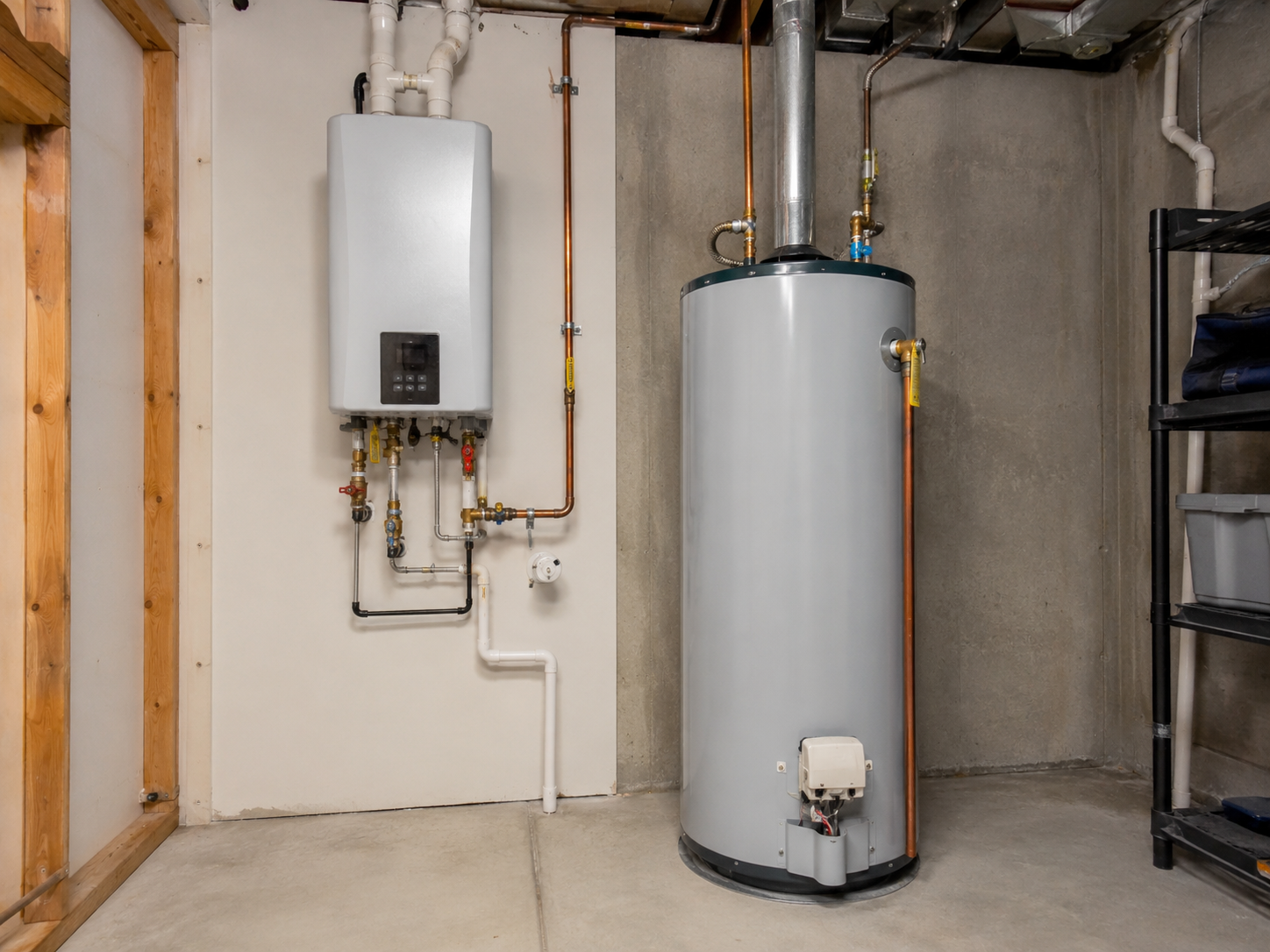
 Tankless water heaters are usually better for long-term efficiency, space savings, and continuous hot water, while traditional water heaters are better for lower upfront cost and simpler replacement. If your household wants lower operating costs and can invest more upfront, tankless may be the stronger choice. If you need a reliable, budget-friendly system with familiar maintenance, a traditional tank water heater still makes sense.
For Denver homeowners, the right choice depends on household size, hot water demand, utility setup, available space, water quality, and installation requirements. This guide compares Tankless vs Traditional Water Heaters so you can make a confident decision before replacing or upgrading your system.
Understanding Tankless Water Heaters
A tankless water heater, sometimes called an on-demand water heater, heats water only when you turn on a hot water fixture. Instead of storing 40 to 75 gallons of hot water in a tank, the unit activates when water flows through it. Gas burners or electric heating elements rapidly warm the water as it passes through the system.
This design is the biggest reason tankless systems are popular. They do not constantly reheat stored water, which can reduce standby energy loss. According to the U.S. Department of Energy, demand-type water heaters can be 24% to 34% more energy efficient than conventional storage tank models for homes using 41 gallons or less of hot water daily, and 8% to 14% more efficient for higher-use homes around 86 gallons per day.
Tankless systems are often a strong fit for homeowners who want:
- More usable space in a basement, closet, garage, or mechanical room
- Longer equipment lifespan when properly maintained
- Better energy performance
- Continuous hot water for normal usage patterns
- A modern upgrade during remodeling or major plumbing work
In Denver, tankless water heaters can be especially appealing in older homes where space is limited or where a finished basement makes a large tank inconvenient. They are also common in remodels, additions, and higher-efficiency home upgrades.
Typical tankless water heater installation costs vary widely because the unit itself is only part of the project. Gas line capacity, venting, electrical work, condensate drainage, water line modifications, and code compliance can all affect the final price. A basic replacement may be manageable, but converting from a tank to tankless can require more planning. For related installation planning, see Water Heaters and What to Know Before Installing a Water Heater in Denver.
Another important factor is water quality. Denver Water notes that hard water can leave mineral buildup and household nuisance deposits, which matters because tankless units often need periodic descaling to protect performance.
Understanding Traditional Water Heaters
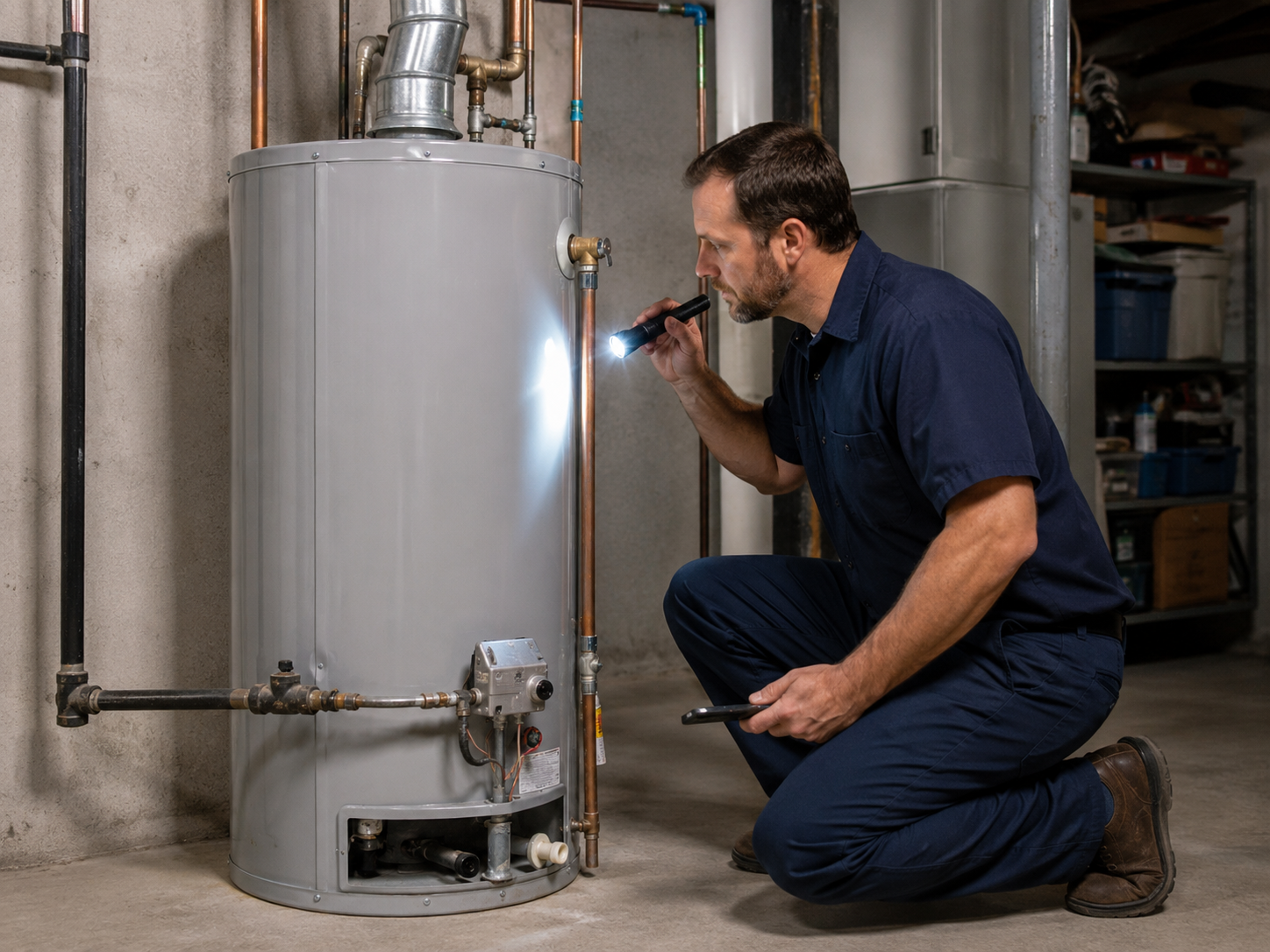 A traditional water heater stores hot water in a tank. Most residential models hold 40, 50, or 75 gallons, although exact capacity depends on the property. The system heats the stored water and keeps it ready until someone turns on a shower, faucet, dishwasher, or washing machine.
Traditional tank water heaters are popular because they are familiar, widely available, and often less expensive to install than tankless systems. If your existing system is already a tank water heater, replacement is usually more straightforward than converting to tankless. That can be important when the old unit fails suddenly and the household needs hot water restored quickly.
Traditional systems are often a strong fit for homeowners who want:
- Lower upfront installation cost
- Simple replacement with fewer plumbing modifications
- Reliable hot water storage
- Easier compatibility with older plumbing setups
- Familiar maintenance and repair options
The main downside is standby heat loss. Because the tank keeps water hot whether you are using it or not, some energy is spent maintaining the water temperature. Efficiency has improved in modern models, but traditional systems still operate differently from on-demand units. The Department of Energy explains that water heater efficiency is measured with Uniform Energy Factor, or UEF, and higher UEF generally means a unit costs less to operate compared with models in the same usage category.
In Denver homes with multiple bathrooms, large families, or back-to-back showers, a properly sized tank can still perform well. However, once the stored hot water is used up, the household has to wait for the tank to recover. This is one of the biggest practical differences in Tankless vs Traditional Water Heaters.
For homes with broader plumbing issues, it may also be smart to evaluate water pressure, valves, and supply lines before choosing a replacement. See General Plumbing, Water Pressure Regulators, and Water / Sewer / Gas Lines
Side-by-Side Comparison
| Attribute | Tankless Water Heater | Traditional Water Heater |
|---|---|---|
| Upfront Cost | Usually higher, especially if gas, venting, electrical, or plumbing upgrades are needed | Usually lower, especially when replacing a similar tank model |
| Operating Efficiency | Often more efficient because water is heated only when needed | Less efficient due to standby heat loss, though newer models are better than older units |
| Hot Water Supply | Can provide continuous hot water within its flow-rate capacity | Limited to the amount of hot water stored in the tank |
| Space Needed | Compact, wall-mounted design saves floor space | Requires more floor space for the storage tank |
| Lifespan | Often longer with proper maintenance and descaling | Usually shorter than tankless, depending on water quality and maintenance |
| Maintenance | Needs periodic flushing/descaling, especially in areas with mineral buildup | Needs flushing, anode rod checks, valve checks, and leak monitoring |
| Installation Complexity | More complex when converting from a tank system | Usually simpler when replacing an existing tank |
| Best For | Efficiency-focused homeowners, remodels, smaller spaces, long-term ownership | Budget-conscious homeowners, fast replacement, predictable hot water demand |
| Common Limitation | Flow rate can be exceeded if too many fixtures run at once | Hot water can run out during heavy use |
| Denver Consideration | May require careful sizing for cold incoming water and household demand | Often easier for like-for-like replacement in older homes |
Pros and Cons Breakdown
Pros of Tankless Water Heaters
- Higher energy efficiency: Since the system heats water only when needed, it can reduce wasted energy compared with storage systems.
- Continuous hot water: Properly sized units can support long showers and back-to-back use without “emptying” a tank.
- Space-saving design: A wall-mounted tankless unit can free up valuable floor space in smaller Denver homes, townhomes, and finished basements.
- Long-term value: Higher upfront cost can be balanced by energy savings and longer expected service life.
- Modern performance: Many units offer advanced controls, diagnostics, and efficiency features.
Cons of Tankless Water Heaters
- Higher installation cost: Conversions may require gas line, venting, electrical, or drainage upgrades.
- Flow-rate limits: Running multiple showers, laundry, and dishwasher at the same time may exceed the unit’s capacity.
- Maintenance sensitivity: Mineral buildup can reduce performance if the unit is not flushed or descaled.
- More complex installation: Proper sizing is critical, especially in colder climates where incoming water temperatures are lower.
- Possible delay at fixtures: Some homes may experience a short wait for hot water unless a recirculation setup is installed.
Pros of Traditional Water Heaters
- Lower upfront cost: Tank models are usually more affordable to purchase and install.
- Straightforward replacement: If you already have a tank, swapping it for a similar unit can be simpler.
- Reliable stored hot water: A properly sized tank can handle normal household routines well.
- Familiar service process: Most plumbers can repair, replace, and maintain tank systems efficiently.
- Good for urgent replacements: If your current unit fails, a traditional replacement may restore hot water faster.
Cons of Traditional Water Heaters
- Hot water can run out: Once the tank is depleted, you must wait for recovery.
- More space required: The tank takes up floor area in a utility room, basement, closet, or garage.
- Standby energy loss: The system keeps stored water hot even when no one is using it.
- Leak risk: Aging tanks can corrode and leak, sometimes causing water damage.
- Shorter lifespan: Traditional tanks usually need replacement sooner than well-maintained tankless systems.
Which Option is Better? The Ultimate Showdown
The best answer in Tankless vs Traditional Water Heaters depends on your goal. There is no universal winner for every home, but there are clear winners for specific situations.
Choose a tankless water heater if your priority is long-term efficiency, space savings, and continuous hot water. It is often the better option if you plan to stay in the home for several years, are already remodeling, want to improve energy performance, or need to reclaim space in a utility area. ENERGY STAR notes that certified gas tankless water heaters heat water only when needed and provide continuous hot water delivery.
Choose a traditional water heater if your priority is lower upfront cost, faster replacement, and simpler installation. It is often the better option when your existing tank fails unexpectedly, your budget is tight, or your home already has a good setup for a storage tank.
For cost, traditional water heaters usually win upfront. Tankless systems usually win over time when the installation is properly designed and the homeowner keeps up with maintenance. That means the decision is less about “cheap vs expensive” and more about short-term budget vs long-term operating value.
For performance, tankless systems can win if they are sized correctly. However, sizing matters. A small tankless unit may struggle if several fixtures run at once. A traditional tank may be more forgiving for short bursts of high demand because it has stored hot water ready.
For space, tankless wins clearly. A wall-mounted unit can make a big difference in tight Denver mechanical rooms, condos, and older homes where storage space is limited.
For simplicity, traditional wins. A like-for-like tank replacement is often more direct than a tankless conversion. Denver’s permitting and installation requirements should also be considered. The City and County of Denver lists quick permit categories for plumbing, mechanical, and related work, and its water-heating equipment requirements show that some gas-fired water heater projects may need specific review depending on building type and project scope.
For Denver winters, the incoming water temperature can affect tankless sizing. Colder incoming water requires more temperature rise to reach comfortable shower temperatures, so a unit that works well in a warmer region may not perform the same in Colorado. This is where a professional sizing calculation matters.
For older homes, the comparison becomes more strategic. If the water lines, gas lines, pressure regulator, or fixtures are aging, the water heater choice should be part of a broader plumbing evaluation. Helpful related resources include How Plumbing Inspections Work for Homes, Residential Plumbing Maintenance Plans Denver, and How Often Home Plumbing Should Be Inspected
The practical winner:
- Best for long-term efficiency: Tankless water heater
- Best for lowest upfront cost: Traditional water heater
- Best for small spaces: Tankless water heater
- Best for quick replacement: Traditional water heater
- Best for long showers: Tankless water heater, if correctly sized
- Best for simple maintenance: Traditional water heater
- Best for remodels or upgrades: Tankless water heater
- Best for emergency budget replacement: Traditional water heater
In short, Tankless vs Traditional Water Heaters is a lifecycle decision. Traditional tanks protect your immediate budget. Tankless systems can support a more efficient long-term home strategy.
Get the Right Water Heater Recommendation for Your Denver Home
If you are comparing Tankless vs Traditional Water Heaters, the best next step is not guessing from a product label. The right system depends on your household size, fixture demand, utility setup, venting, available space, and long-term plans for the home.
Denver residents can schedule a professional consultation to compare installation options, review code considerations, and decide whether a tankless upgrade or traditional replacement makes the most sense. Start with the Water Heaters service page to explore repair, replacement, and installation support.
Conclusion & Recommendation
When comparing Tankless vs Traditional Water Heaters, tankless is the stronger long-term choice for efficiency, space savings, and continuous hot water. Traditional water heaters remain the better short-term choice for affordability, fast replacement, and simpler installation.
For most homeowners planning to stay in the property long-term, a properly sized tankless water heater is worth considering. For homeowners who need a practical, budget-conscious replacement, a traditional tank water heater is still a dependable option. The smartest decision comes from matching the system to your home, not just choosing the newest technology.
Frequently Asked Questions
1. Is a tankless water heater better than a traditional water heater?
1. Is a tankless water heater better than a traditional water heater?
A tankless water heater is better if you want higher efficiency, more space, and continuous hot water within the unit’s flow capacity. A traditional water heater is better if you want a lower upfront cost and a simpler replacement. The best choice depends on budget, household demand, and installation requirements.
2. Do tankless water heaters really save money?
2. Do tankless water heaters really save money?
Tankless water heaters can save money on energy because they heat water only when needed. However, the savings must be weighed against higher installation costs. The payback period depends on utility rates, hot water use, maintenance, and whether the home needs gas, venting, or electrical upgrades.
3. Can a tankless water heater run out of hot water?
3. Can a tankless water heater run out of hot water?
A tankless water heater does not run out of stored hot water like a tank system. However, it can be overwhelmed if too many fixtures demand hot water at the same time. Proper sizing is the key to avoiding performance problems.
4. Why are tankless water heaters more expensive to install?
4. Why are tankless water heaters more expensive to install?
Tankless systems may require upgraded gas lines, new venting, electrical changes, condensate drainage, water line adjustments, or code-related modifications. The unit is compact, but the installation can be more technical than replacing a standard tank.
5. Is a traditional water heater still worth buying?
5. Is a traditional water heater still worth buying?
Yes. A traditional water heater is still worth buying when upfront cost, quick replacement, and straightforward installation are the main priorities. Many homes perform well with a properly sized tank water heater, especially when hot water demand is predictable.
6. Which water heater is better for a large family?
6. Which water heater is better for a large family?
A large family may benefit from either option. A large traditional tank can handle short periods of heavy use, while a properly sized tankless system can provide continuous hot water. If several showers, laundry, and dishes often run at once, professional sizing is especially important.
7. How often should tankless water heaters be maintained?
7. How often should tankless water heaters be maintained?
Most tankless water heaters should be flushed or descaled at least once a year, though frequency can vary based on water quality and manufacturer recommendations. Homes with mineral buildup may need more consistent maintenance to protect efficiency and flow.
8. How often should traditional water heaters be flushed?
8. How often should traditional water heaters be flushed?
Traditional water heaters are commonly flushed once a year to reduce sediment buildup. Regular maintenance can improve performance, reduce noise, and help extend the life of the system.
9. Are tankless water heaters good for Denver homes?
9. Are tankless water heaters good for Denver homes?
Yes, tankless water heaters can work well in Denver homes when they are correctly sized for incoming water temperature, household demand, and fixture use. Installation should also account for venting, fuel type, code requirements, and water quality.
10. Should I replace my water heater before it fails?
10. Should I replace my water heater before it fails?
Replacing a water heater before it fails can help prevent leaks, water damage, and emergency installation costs. If your unit is aging, making noise, producing rusty water, leaking, or struggling to keep up, it is smart to compare replacement options early.



